- First, the SEBI Question
- What Has Actually Happened So Far
- SBI Research made a recommendation
- The Finance Minister said she would listen
- Parliament was told there is no proposal
- Fresh reports suggest a cut is being weighed
- What Foreign Investors Pay Today
- A quick worked example
- Why the Idea Is Gaining Ground
- Why It May Not Be Simple
- Tax is only one reason money moves
- Selective relief is messy to design
- The revenue question is real
- How It Could Play Out
- What This Means for Different Investors
- If you’re a retail investor
- If you track FII flows
- If you’re a trader
- The Bottom Line
- Sources Referenced
If you’ve seen a headline claiming SEBI is getting ready to wipe out long-term capital gains tax for foreign institutional investors, pause before you share it. The story is real in parts, muddled in others, and wrong in one important detail: SEBI doesn’t decide tax rates.
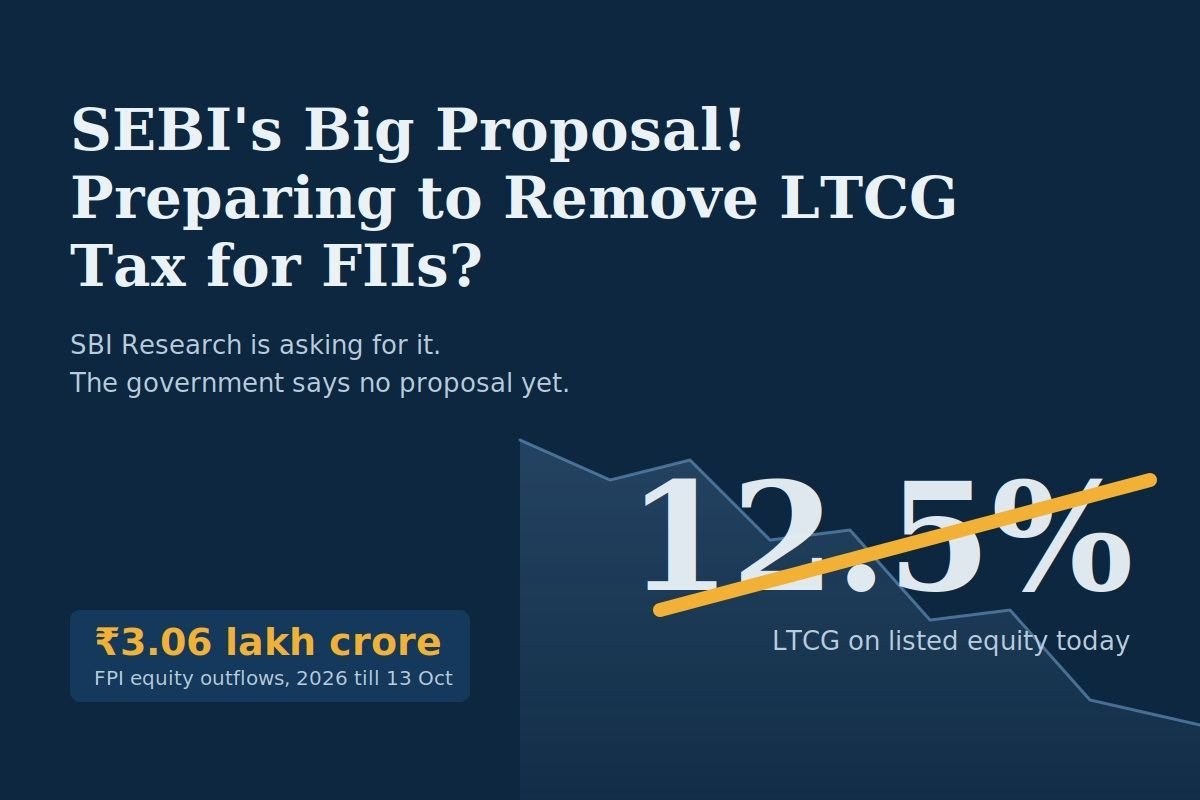
Still, the underlying debate is very much alive. Foreign money has been leaving Indian stocks in large amounts this year, and a growing number of voices, from economists to fund managers, are asking whether the 12.5% LTCG tax is part of the problem. This article separates what has actually been said, who said it, and what it could mean for investors if anything changes.
First, the SEBI Question
SEBI is the market regulator. It writes rules on disclosures, trading, market structure and investor protection. Tax rates sit with the Finance Ministry and are changed through the Finance Bill, usually during the Union Budget, which is typically presented on 1 February, or through an ordinance.
So when a headline says “SEBI proposes” a tax cut, it is usually shorthand for a broader discussion that involves the regulator, the government and market participants. SEBI can recommend or lobby. It cannot legislate a tax change on its own.
What Has Actually Happened So Far
The timeline matters, because several separate events are getting blended into one story.
SBI Research made a recommendation
In October 2026, SBI Research suggested that the Centre remove LTCG tax on equities. The thinking is that a tax-free long-term holding would nudge foreign investors toward staying longer, which would reduce the sudden exits that put pressure on the rupee. Reports indicate the idea was paired with a longer qualifying holding period of two to three years instead of the current twelve months.
That is a research view, not a policy decision.
The Finance Minister said she would listen
In May 2026, Finance Minister Nirmala Sitharaman said the government was open to hearing investor concerns about LTCG and short-term capital gains taxation. She did not announce a review or a rate change. Markets read it as a signal of willingness to talk, and little more.
Parliament was told there is no proposal
On 21 July 2026, the Finance Ministry answered a Rajya Sabha question on scrapping LTCG by saying no such proposal was under consideration. The reply added that capital gains rates are reviewed as part of the regular budget cycle.
Fresh reports suggest a cut is being weighed
In late October, a news report said the Centre was considering ways to make India’s tax regime more appealing to foreign investors, including a possible LTCG reduction. Around the same time, another report quoted a senior government functionary saying a capital gains cut for FPIs wasn’t being considered “at this point in time” and that recent outflows were strategic rather than a verdict on India.
Put together, the honest reading is this: the idea is being discussed, the government has not committed to it, and officials are sending mixed signals.
What Foreign Investors Pay Today
Foreign portfolio investors pay LTCG on listed equity at 12.5% when they sell after holding for more than twelve months. Gains from shares sold within a year are taxed at 20% as short-term gains. The long-term rate was raised from 10% to 12.5% in the 2024 Budget.
One thing is already different for debt. Under the Income-tax (Amendment) Ordinance, 2026, FPI investments in government securities were exempted from tax on interest and capital gains from 1 April 2026. That relief was aimed at attracting stable money into the bond market. Equity was left untouched, which is partly why the equity LTCG conversation has gotten louder.
A quick worked example
Say an overseas fund buys shares for ₹10 crore and sells them 14 months later for ₹14 crore.
- Gain: ₹4 crore
- LTCG at 12.5%: ₹50 lakh (before any surcharge or cess, and subject to treaty position)
- If LTCG were zero, the fund would keep the full ₹4 crore
Scale that across the portfolios of large funds and you can see why a tax tweak gets taken seriously. You can also see why the government hesitates. Equity LTCG collections were around ₹1.29 lakh crore for assessment year 2025-26, which is revenue no finance ministry gives up lightly.
Why the Idea Is Gaining Ground
Foreign investors have been net sellers in a big way. Reports put FPI withdrawals from Indian equities at roughly ₹3.06 lakh crore in 2026 through mid-October. When that much money leaves, the rupee feels it, large-cap stocks wobble and sentiment turns cautious.
Supporters of a tax cut make a few arguments:
- Patient capital deserves a reward. A tax-free long-term gain encourages investors to stay put.
- India competes with other markets. Fund managers compare after-tax returns across countries, and a lower tax helps India’s case at the margin.
- The present system stacks taxes. Investors already pay securities transaction tax on every trade, and then capital gains tax on top.
Why It May Not Be Simple
Tax is only one reason money moves
Foreign flows respond to US interest rates, the dollar, rupee expectations, earnings growth and valuations. A tax cut can improve the story, but it rarely overrides those forces. Several market commentators have made exactly this point: relief may lift sentiment without turning flows around on its own.
Selective relief is messy to design
Fund manager Samir Arora argued earlier this year that tax breaks for only some foreign investors would not work well. Many large global investors, such as pension funds and endowments, don’t buy Indian shares directly. They hold Indian ETFs listed overseas or invest through treaty structures that already change their tax picture. His preference was a zero LTCG rate for everyone, domestic and foreign, which is a far more expensive proposition for the exchequer.
The revenue question is real
A broad exemption costs money. A narrow one raises fairness questions: why should a foreign fund pay less tax than a resident retail investor holding the same share? Any serious proposal has to answer that.
How It Could Play Out
Nobody outside the Finance Ministry knows, but the realistic paths look like this:
- Nothing changes. The 12.5% rate and the twelve-month holding period stay as they are.
- A modest rate cut. LTCG could be lowered, possibly for everyone, possibly with conditions.
- A longer holding period with a lower or zero rate. This follows the SBI Research idea, though it would hurt anyone who sells in between.
- Adjustments elsewhere. Raising the annual LTCG exemption (currently ₹1.25 lakh for residents) or trimming STT are softer options that cost less.
If something is coming, the Union Budget is the most likely place to see it.
What This Means for Different Investors
If you’re a retail investor
Nothing changes for you today. Taking a simple case: you book ₹3 lakh in long-term gains. After the ₹1.25 lakh exemption, ₹1.75 lakh is taxable, and 12.5% of that is about ₹21,875 before cess. Don’t postpone a sale you genuinely need to make just because of rumours. Tax outcomes depend on actual law, not headlines.
If you track FII flows
Watch for official statements, not social media posts. Markets have already rallied on hints of relief at times, and the same threads usually warn that expectation is not confirmation.
If you’re a trader
Treat the topic as a source of volatility around budget time rather than a basis for positioning today.
The Bottom Line
The catchy version of the story, “SEBI is about to scrap LTCG for FIIs”, doesn’t hold up. The accurate version is more interesting: a credible research body has called for it, the Finance Minister has said she’s listening, Parliament was told there’s no proposal, and fresh reports say the Centre is weighing options. That’s a debate in progress, not a decision.
For now, plan around today’s rules. If you invest in Indian equities, keep an eye on the next Budget and treat unconfirmed headlines with some healthy skepticism.
Disclaimer: This article is for general information and is not tax or investment advice. Consult a qualified tax professional for your specific situation.
Sources Referenced
- Rajya Sabha Unstarred Question No. 252, Ministry of Finance, answered 21 July 2026
- Outlook Money and Outlook Business coverage of SBI Research’s recommendation and FPI outflows
- Business Today and Free Press Journal coverage of Samir Arora’s views
- Mint, Asianet and Multibagg reports on the Finance Minister’s May 2026 remarks
- KNN India report dated 27 October 2026 on the Centre weighing a cut
- NiftyTrader report on the FPI G-secs exemption under the Income-tax (Amendment) Ordinance, 2026