- What Exactly Happened
- Why the “Confidential” Route Matters
- Who Is Zetwerk, and What Does It Actually Do?
- Sectors and Services
- Why the Timing Makes Sense
- Issue Structure: What’s Known and What Isn’t
- What’s Confirmed
- What’s Being Reported, But Not Yet Confirmed
- A Possible Pre-IPO Round
- The Bankers Behind the Deal
- Financial Snapshot: A Mixed but Improving Picture
- Gross Merchandise Value Actually Declined
- But Losses Narrowed Sharply
- Revenue Guidance for FY26
- Who’s Backing Zetwerk?
- How Zetwerk Fits Into the Broader IPO Market
- What Happens Next
- Frequently Asked Questions
- Final Thoughts
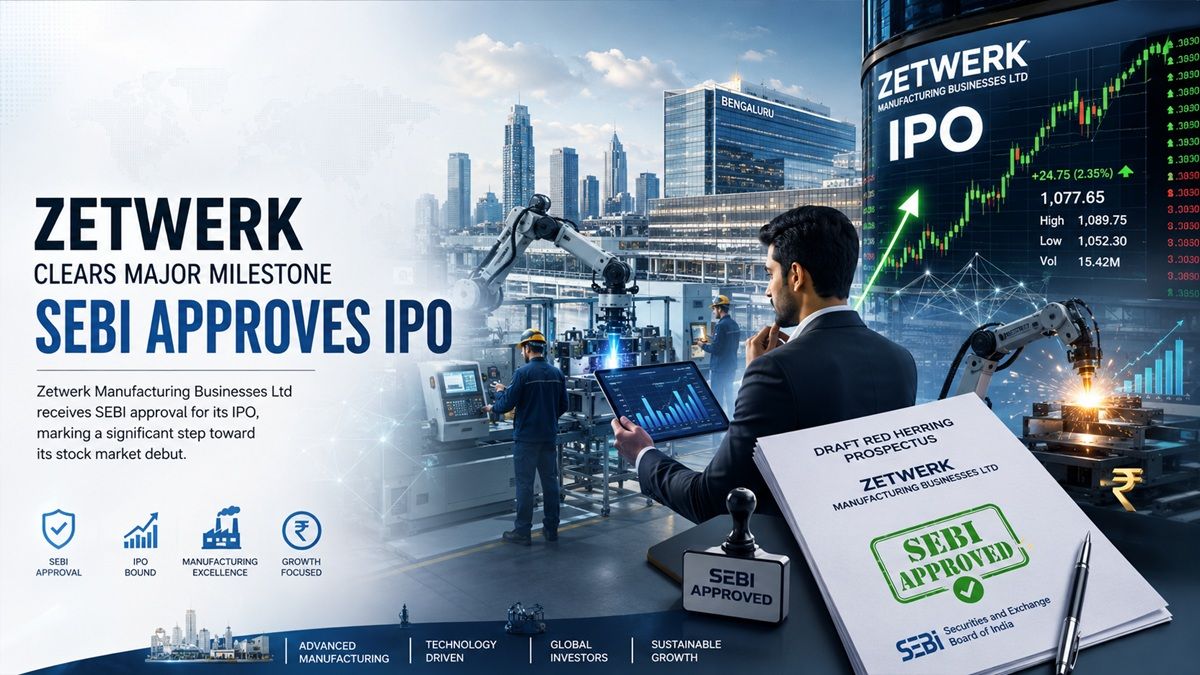
Bengaluru’s manufacturing-tech scene just got a notable stock market milestone. Zetwerk Manufacturing Businesses Ltd has cleared one of the biggest hurdles on the road to a public listing — regulatory sign-off from SEBI — and that single piece of news has already set off a wave of speculation about valuation, issue size, and timing.
If you’ve been watching India’s IPO pipeline this year, Zetwerk’s name has probably come up before. It’s one of the more closely tracked new-age manufacturing companies, backed by a roster of marquee global investors, and its path to listing has been unfolding quietly through SEBI’s confidential filing route rather than the usual public draft prospectus route most companies use.
Here’s what the SEBI approval actually means, what Zetwerk does, and what to watch for as the IPO moves toward its next stage.
What Exactly Happened
According to SEBI’s processing status report dated July 10, 2026, the regulator issued its observations on Zetwerk’s pre-filed draft offer document during the week of July 6 to July 10, with the specific sign-off landing on July 9. In SEBI’s own regulatory language, “issuing observations” is essentially shorthand for approval to proceed with floating the IPO.
Zetwerk wasn’t alone in getting the green light that week. SEBI also cleared IPO plans for three other companies around the same time — Marri Retail, Tonbo Imaging India, and Gujarat Victory Forgings — all of which had filed their preliminary papers between December 2025 and April 2026. Zetwerk’s own pre-DRHP was filed on April 1, 2026, meaning the company waited a little over three months to clear the regulatory review.
Why the “Confidential” Route Matters
One detail that sets Zetwerk’s process apart from a typical mainboard IPO is the route it used. Instead of filing a public Draft Red Herring Prospectus that anyone could read the moment it landed with SEBI, Zetwerk opted for the confidential pre-filing mechanism. This route lets a company get SEBI’s initial feedback on its draft offer document without disclosing detailed financials, issue structure, or valuation publicly at that early stage.
It’s a route that’s gained popularity among larger, more high-profile companies recently — Razorpay, the National Stock Exchange, and Jio Platforms have all pursued similar confidential filings. The appeal is fairly straightforward: it gives companies more control over the timing of their eventual public listing announcement and shields sensitive commercial details from competitors for as long as possible before the actual IPO launch.
Who Is Zetwerk, and What Does It Actually Do?
Zetwerk was founded in 2018 by Amrit Acharya, Srinath Ramakkrushnan, Vishal Chaudhary, Ankit Fatehpuria, and Rahul Sharma. At its core, the company runs a technology-enabled manufacturing platform that connects industrial customers with a network of manufacturing facilities and suppliers, functioning as a bridge between demand and available production capacity.
Think of it less like a traditional factory owner and more like an orchestration layer sitting on top of India’s manufacturing ecosystem — matching companies that need parts, components, or full products built with the manufacturers who have the capacity and capability to build them.
Sectors and Services
Zetwerk’s platform spans a fairly wide industrial footprint, covering:
- Energy infrastructure manufacturing
- Electronics and PCB manufacturing
- Aerospace and defence components
- Capital goods production
The company hasn’t stayed confined to being purely a marketplace, either. Over time, it has expanded into end-to-end industrial manufacturing of its own, including entering product categories like laptops, wearables, hearables, and other IT hardware. It also runs a raw material procurement platform, which gives it another revenue stream by helping client companies manage their supply chains more efficiently rather than sourcing materials independently.
Why the Timing Makes Sense
Zetwerk’s business model is riding two fairly powerful tailwinds at once. The first is the broader global shift in supply chains away from heavy reliance on a single manufacturing hub — often described as the “China+1” strategy — which has pushed more international demand toward Indian manufacturing capacity. The second is domestic: the Indian government’s ongoing push to boost local industrial output, particularly in defence and electronics manufacturing, aligns closely with the sectors Zetwerk already serves.
Layer on top of that the company’s exposure to manufacturing contracts tied to AI data centre buildouts — a segment expected to see substantial capital spending over the next few years — and it’s not hard to see why investment banks were willing to line up behind this listing.
Issue Structure: What’s Known and What Isn’t
Here’s the honest picture. Because Zetwerk used the confidential filing route, a lot of the specifics that would normally be public by this stage — exact issue size, price band, and precise financial breakdowns — remain undisclosed for now.
What’s Confirmed
- The IPO will include both a fresh issue of equity shares and an Offer for Sale (OFS) by existing shareholders.
- The final issue size and company valuation will be determined through the book-building process closer to launch.
- The company filed its pre-DRHP on April 1, 2026, and received SEBI’s observations on July 9, 2026.
What’s Being Reported, But Not Yet Confirmed
Multiple media reports have floated different fundraise estimates, and it’s worth being upfront that these numbers don’t fully agree with each other:
- One widely cited figure, attributed to Moneycontrol, pegs the target raise at around ₹4,200 crore (roughly $450 million).
- Other reports citing people familiar with the matter suggest a broader range of ₹4,000 crore to ₹5,000 crore.
- At least one industry tracker has put the figure considerably higher, at approximately ₹6,700 crore.
Why the numbers don’t match: This kind of spread isn’t unusual for a company that’s used the confidential filing route. Since the detailed offer document hasn’t been made public, most of these figures come from unnamed sources or early estimates rather than the company’s own disclosed filings. Treat all of them as directional until Zetwerk’s actual DRHP or RHP becomes public with confirmed numbers.
A Possible Pre-IPO Round
Ahead of the public listing, reports also suggest Zetwerk is weighing a pre-IPO funding round of somewhere between $50 million and $60 million, targeting a valuation close to $3 billion. If that round goes through before the IPO launches, it would give the market an early, concrete signal of how investors are pricing the company ahead of the public book-building process.
The Bankers Behind the Deal
Zetwerk has assembled a genuinely heavyweight syndicate to manage this listing. Kotak Mahindra Capital is leading the group, with JM Financial, Avendus Capital, and Pantomath Capital also involved from the domestic side. On the global front, the Indian arms of Goldman Sachs, Morgan Stanley, and HSBC round out what’s being described as a six-bank syndicate.
That’s a notably large and internationally weighted group of lead managers for an Indian IPO, and it tends to signal two things: the company is targeting significant institutional demand, potentially including a meaningful allocation to foreign investors, and the deal size is expected to be large enough to justify spreading underwriting responsibility across multiple firms.
Financial Snapshot: A Mixed but Improving Picture
Zetwerk’s financials tell a genuinely nuanced story, and it’s worth looking at both sides rather than only the flattering parts.
Gross Merchandise Value Actually Declined
The company’s Gross Merchandise Value (GMV) — a metric commonly used for marketplace-style businesses to represent the total value of transactions flowing through the platform — stood at ₹12,798 crore in FY25, down from ₹14,443 crore in FY24. That’s a year-on-year decline of roughly 11%, and it’s not a detail to gloss over just because other numbers look more encouraging.
But Losses Narrowed Sharply
On the profitability side, the picture improves considerably. Net loss narrowed to ₹371 crore in FY25, down from ₹918 crore the year before — a reduction of nearly 60%. That kind of improvement, even against declining GMV, generally points to a deliberate shift toward better unit economics: possibly moving away from lower-margin transactional volume toward higher-value, higher-margin manufacturing contracts.
Revenue Guidance for FY26
Looking ahead, the company has indicated it expects to cross $2 billion in revenue for FY26, with growth partly attributed to manufacturing contracts tied to AI data centre infrastructure — a category that’s seen a sharp rise in capital investment globally over the past couple of years.
Put together, this financial picture reads less like a company scaling revenue at all costs and more like one trying to demonstrate a credible path toward sustainable profitability ahead of going public — a positioning that tends to matter a great deal to institutional investors evaluating a listing in the current market environment, where “growth at any cost” stories have fallen out of favor.
Who’s Backing Zetwerk?
Zetwerk’s investor base reads like a fairly comprehensive list of global venture and growth capital names. Among its backers are Khosla Ventures, Baillie Gifford, Accel, Peak XV Partners, GreenOak, and Lightspeed, along with a notable individual investor — IndiGo co-founder Rakesh Gangwal.
Reports have also pointed to a second high-profile investor exit taking shape ahead of the IPO, though full details on which investor and what portion of their stake weren’t specified in early coverage. Since the IPO structure includes an Offer for Sale component, it’s reasonable to expect some existing shareholders — likely a mix of early investors and possibly some employee shareholders — to use the listing as a partial exit opportunity, which is a fairly standard feature of most large tech-adjacent IPOs at this stage.
How Zetwerk Fits Into the Broader IPO Market
Zetwerk’s approval lands amid what’s been described as an active, though increasingly selective, IPO market in India. A number of high-profile companies — Razorpay, the National Stock Exchange, and Jio Platforms among them — have also chosen the confidential pre-filing route this cycle, suggesting larger, well-funded private companies are increasingly favoring more controlled, staged disclosure over the traditional fully public DRHP process.
The same week Zetwerk cleared SEBI’s review, Tonbo Imaging (a defence electronics manufacturer), Marri Retail (an apparel and jewellery retailer), and Gujarat Victory Forgings (a non-ferrous metals manufacturer) also received their observation letters — a reminder that India’s primary market continues to see steady deal flow across very different sectors, from consumer retail to defence technology to industrial manufacturing.
What Happens Next
SEBI approval is a meaningful checkpoint, but it isn’t the finish line. Here’s roughly what typically follows from this stage:
- The company finalizes its detailed offer document, including audited financials, use-of-proceeds breakdown, and risk factors.
- A public Red Herring Prospectus (RHP) is filed closer to the actual launch, at which point the price band, exact issue size, and lot size become public.
- Anchor investor bidding typically opens a day or two before the public subscription window.
- The IPO opens for public subscription across retail, NII, and QIB categories.
- Allotment is finalized, followed by listing on the stock exchanges.
Given that SEBI’s observation letters are typically valid for a defined window, Zetwerk will likely need to launch its public offering within the coming months rather than sitting on the approval indefinitely, though exact timing has not yet been disclosed.
Frequently Asked Questions
- What does SEBI approval for an IPO actually mean?
It means SEBI has reviewed the company’s draft offer document and issued its observations, which is regulatory language for giving the company clearance to proceed with launching its public issue. It doesn’t set the price, date, or final issue size — those come later.
- When will the Zetwerk IPO open for subscription?
No specific dates have been announced yet. Since Zetwerk used the confidential pre-filing route, the public RHP with firm dates and pricing is expected to follow at a later stage.
- How much is Zetwerk expected to raise through its IPO?
Estimates vary across media reports, ranging from around ₹4,200 crore to as high as ₹6,700 crore. The final figure will only be confirmed once the detailed offer document is made public.
- What does Zetwerk actually manufacture or provide?
Zetwerk runs a technology-enabled manufacturing platform connecting industrial customers with manufacturing capacity across sectors like energy, electronics, aerospace, and defence. It has also moved into direct manufacturing of products like laptops, wearables, and IT hardware, alongside a raw material procurement platform.
- Is Zetwerk profitable?
Not yet, but its losses have narrowed significantly — from ₹918 crore in FY24 to ₹371 crore in FY25 — even as its Gross Merchandise Value declined over the same period, suggesting a shift toward better margins rather than pure volume growth.
- Who are Zetwerk’s major investors?
The company counts Khosla Ventures, Baillie Gifford, Accel, Peak XV Partners, GreenOak, Lightspeed, and IndiGo co-founder Rakesh Gangwal among its backers.
- Which banks are managing the Zetwerk IPO?
Kotak Mahindra Capital is leading the syndicate, alongside JM Financial, Avendus Capital, Pantomath Capital, and the Indian arms of Goldman Sachs, Morgan Stanley, and HSBC.
Final Thoughts
Zetwerk clearing SEBI’s review is a genuine milestone, but it’s really the start of the next phase rather than a conclusion. The company enters this stage with real strengths — a differentiated manufacturing-platform model, exposure to defence and AI infrastructure demand, and a heavyweight group of global backers and bankers behind it. At the same time, the financial picture isn’t a straightforward growth story; a declining GMV alongside sharply narrowing losses is the kind of detail that deserves a closer look once full financials become public, rather than being smoothed over by the more headline-friendly loss-reduction number.
For now, the smartest approach is to treat every fundraise and valuation figure circulating in the press as provisional. Once Zetwerk’s detailed offer document becomes public, investors will finally get the numbers that actually matter — price band, precise financials, and use-of-proceeds — and that’s the point at which a real assessment of the IPO becomes possible rather than an exercise in reading between the lines of confidential filings.
Disclaimer: This article is for informational purposes only and does not constitute investment advice. Details mentioned here are based on media reports available at the time of writing and are subject to change as Zetwerk’s IPO process progresses. Please consult a SEBI-registered investment advisor and read the official offer documents once they are published before making any investment decision.