- What the company does
- Key dates
- Price band and lot size
- Issue structure
- GMP today
- Company review — should you apply?
- Frequently Asked Questions
- What is the Manipal Payment and Identity Solutions IPO price band?
- Why did Manipal Payment and Identity Solutions’ profit fall in FY26?
- Is Manipal Payment IPO’s retail quota small?
- Conclusion
Manipal Cards, as it’s known in trade circles, is one of India’s biggest payment card manufacturers, and it’s finally bringing that business to the public markets. But the financial story here is more mixed than the brand name might suggest. Here’s the full picture.
What the company does
Manipal Payment and Identity Solutions has been operating since 2008 as part of The Manipal Group. It’s one of the largest payment card manufacturers in the country, holding an estimated 36.4% share of India’s credit card issuance market and close to 31% of the debit card market in FY26. Beyond cards, the business spans identity documents, secure printing, cheque products, NFC and QR-based payment tech, and IoT/smart tagging solutions, with a customer base of over 300 banks, fintechs and NBFCs — more than 61% of whom have stuck around for over five years. It also has an international footprint across the UK, Europe, Asia-Pacific and the Middle East.
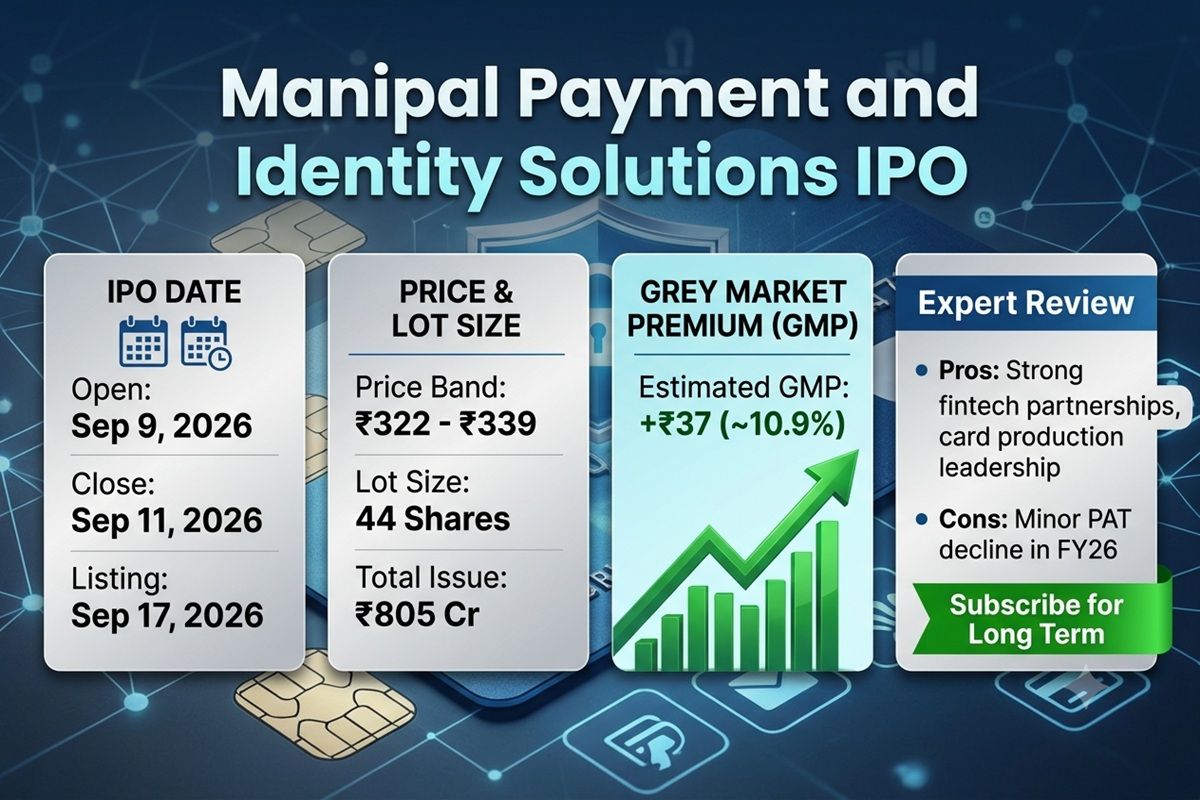
Key dates
| Event | Date |
|---|---|
| IPO opens | September 9, 2026 |
| IPO closes | September 11, 2026 |
| Allotment finalisation | September 15, 2026 |
| Listing on NSE & BSE | September 17, 2026 |
Price band and lot size
The band is set at ₹322 to ₹339 per share, with a lot size of 44 shares — that’s roughly ₹14,916 for one retail lot at the top end.
Issue structure
This is an ₹805 crore issue: ₹320 crore fresh issue, and roughly ₹485 crore offer for sale by promoter Manipal Technologies Limited. That OFS portion works out to around 60% of the total offer, meaning a majority of what’s raised goes to the promoter, not into the business. Worth flagging too: the retail quota on this one is only up to 10% of the net offer, noticeably thin compared to most mainboard issues where retail typically gets 35%.
GMP today
GMP has held fairly steady in the ₹25 to ₹37 range through the run-up to opening, translating to roughly an 8-11% expected listing premium depending on the day you check. That’s a modest, unspectacular number — not a red flag, but not the kind of grey market enthusiasm that suggests a blockbuster debut either.
Company review — should you apply?
The financial story here is genuinely mixed, which is unusual for an IPO this well marketed. FY26 revenue came in at ₹1,326.75 crore, but profit after tax actually fell around 10% year-on-year to ₹253.46 crore, largely because FY25 included a one-off exceptional gain of roughly ₹110 crore that flattered the prior year’s base.
Margins are strong on paper — EBITDA margin above 33%, ROE close to 29% — and the company has all but wiped out its debt, down from ₹472.87 crore to just ₹0.42 crore in a year. But operating cash flow has been on a declining trend across the last three fiscals, and at the upper band you’re paying roughly 31 times earnings for a business whose profit just went backwards. This one calls for reading the related-party transaction disclosures carefully before deciding — the story looks good from a distance and gets more complicated up close.
Frequently Asked Questions
What is the Manipal Payment and Identity Solutions IPO price band?
₹322 to ₹339 per share, with a lot size of 44 shares.
Why did Manipal Payment and Identity Solutions’ profit fall in FY26?
FY25 profit included a one-off exceptional gain of around ₹110 crore that inflated the prior-year base, making FY26’s underlying profit look like a decline year-on-year.
Is Manipal Payment IPO’s retail quota small?
Yes — retail investors get only up to 10% of the net offer, well below the 35% typical for most mainboard IPOs.
Conclusion
Manipal Payment and Identity Solutions has real scale and a genuinely diversified product mix across payments, identity and secure printing, but the FY26 profit decline, falling operating cash flow and thin retail allocation are all worth weighing carefully before applying. Read the RHP’s related-party disclosures closely — this is not a straightforward “big brand, safe bet” story.
GMP figures mentioned above are unofficial, unregulated grey market indicators that change frequently. They are not a guarantee of listing price. Please review the RHP and consult your financial advisor before applying.