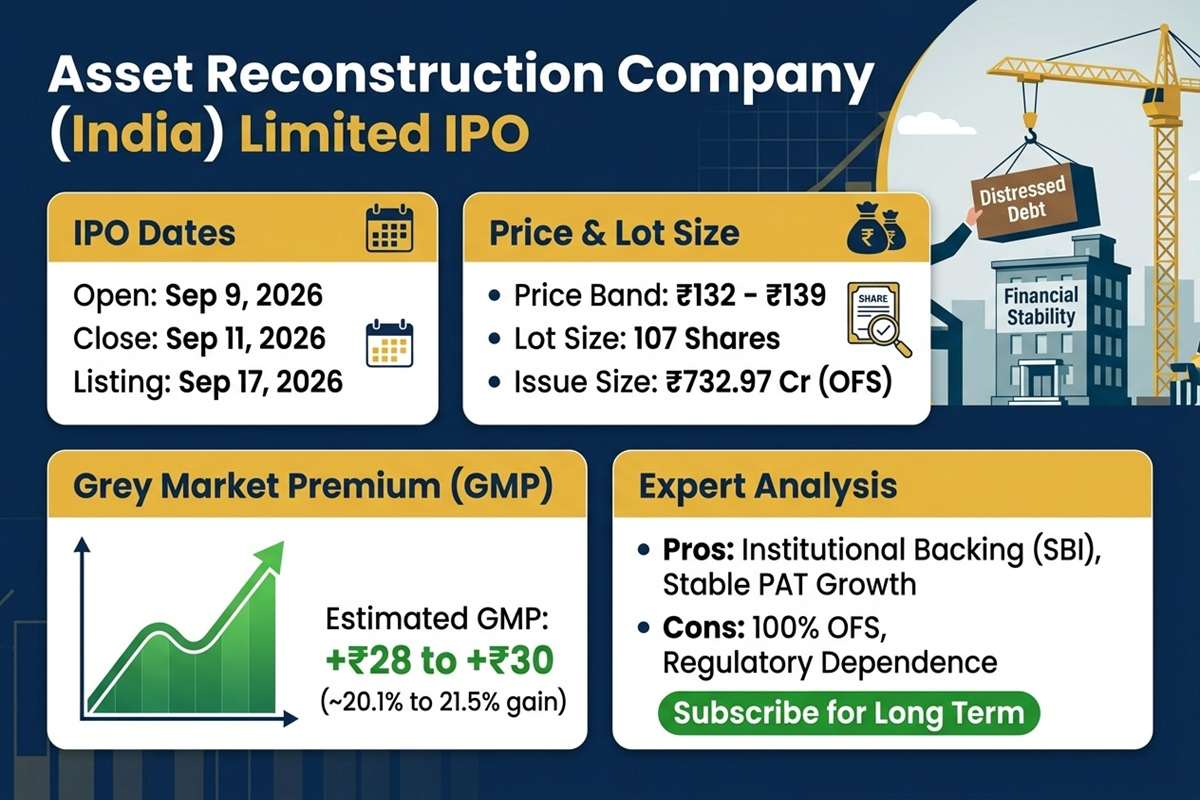
This one carries a genuinely historic tag: if it lists as planned, ARCIL becomes the first-ever asset reconstruction company to trade on Indian exchanges. There’s no other business quite like it currently listed in India, which makes it both interesting and hard to value on comparables. Here’s the full picture.
What the company does
Asset Reconstruction Company (India) Limited, universally known as ARCIL, was India’s first asset reconstruction company, incorporated in 2002 and registered with the RBI in August 2003. Its business is buying distressed, non-performing loans from banks and financial institutions and then working to recover value through restructuring, settlements, legal enforcement and collections. Its major shareholders are Avenue Capital Group (through Avenue India Resurgence Pte Ltd, holding close to 70%) and State Bank of India, which holds around 20%, alongside other investors including Lathe Investment Pte Ltd, Federal Bank, Karnataka Bank and South Indian Bank.
Key dates
| Event | Date |
|---|---|
| Anchor investor bidding | September 8, 2026 |
| IPO opens | September 9, 2026 |
| IPO closes | September 11, 2026 |
| Allotment finalisation | September 15, 2026 |
| Listing on NSE & BSE | September 17, 2026 |
Price band and lot size
The band is ₹132 to ₹139 per share, with a lot size of 107 shares — around ₹14,873 for one retail lot at the upper price.
Issue structure
This is a roughly ₹733-805 crore issue, and it’s entirely an offer for sale — about 5.27 crore shares being sold by existing shareholders including Avenue Capital, SBI, Lathe Investment Pte Ltd and Federal Bank. There is zero fresh capital coming into the company itself through this listing; it’s purely a liquidity event for the people who already own it.
GMP today
GMP has been unusually inconsistent across trackers for this one — some showing it flat at ₹0 through much of the run-up, others reporting figures between ₹15 and ₹56 depending on the day. Given the historic “first ARC to list” narrative, some of that spread likely reflects genuine uncertainty about how to value a business type that’s never traded on Indian exchanges before, rather than any single tracker being wrong.
Company review — should you apply?
ARCIL’s numbers are those of a mature, steadily profitable financial services business rather than a growth story: FY26 total income came in around ₹749-785 crore, with profit after tax between ₹352 crore and ₹408 crore depending on the reporting basis, and EBITDA margins comfortably above 70%. Net worth stands at a healthy ₹3,000+ crore with conservative gearing.
The appeal here is straightforward — it’s the only pure-play, RBI-regulated asset reconstruction business you’ll be able to buy on Indian exchanges, with two decades of operating history and backing from a global distressed-debt specialist and India’s largest public sector bank. The catch is equally straightforward: since this is a 100% OFS, the listing does nothing to strengthen ARCIL’s own balance sheet, and the business itself is inherently cyclical — its fortunes are tied to how much stressed debt is floating around the banking system and how efficiently ARCIL can recover value from it, which isn’t always a smooth or predictable curve.
Frequently Asked Questions
What is the ARCIL IPO price band?
₹132 to ₹139 per share, with a lot size of 107 shares.
Is ARCIL IPO a fresh issue or offer for sale?
It’s entirely an offer for sale — roughly 5.27 crore shares sold by existing shareholders, with no fresh capital going into the company.
Why is ARCIL’s IPO historically significant?
It would become the first-ever asset reconstruction company to list on Indian stock exchanges, giving investors a genuinely new category of business to buy into.
Conclusion
ARCIL offers something you simply can’t buy anywhere else on the Indian exchanges — a mature, profitable, RBI-regulated ARC with two decades of track record. But the 100% OFS structure and the sector’s inherent tie to the banking NPA cycle mean this isn’t a straightforward growth story. Treat it as a scarcity play and size your position accordingly.
GMP figures mentioned above are unofficial, unregulated grey market indicators that change frequently and have shown notable inconsistency across trackers for this issue. They are not a guarantee of listing price. Please review the RHP and consult your financial advisor before applying.