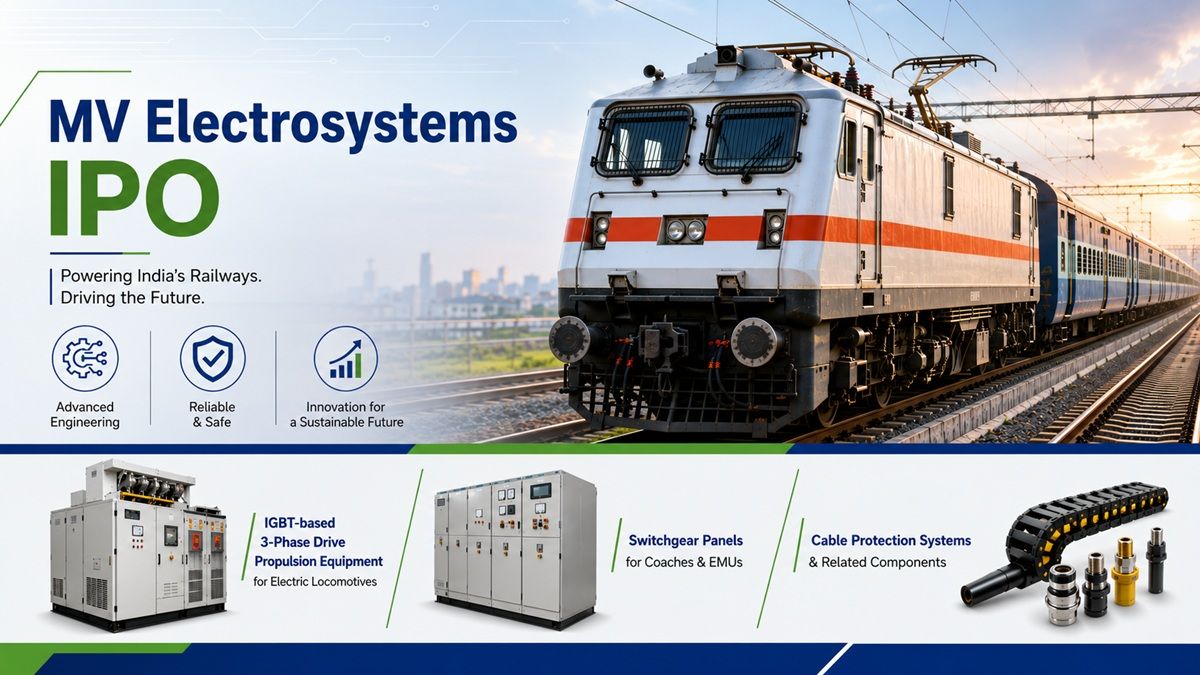
Every time an Indian Railways train pulls out of a station, there’s a good chance a small, unglamorous piece of electronics inside the locomotive is doing the actual work of converting power into motion. MV Electrosystems makes exactly that kind of equipment, and after more than fifteen years of building a niche business around railway propulsion technology, it’s now heading to the public markets with a mainboard IPO that opens in just a few days.
This is one of those IPOs where the story isn’t simple. There’s a genuinely strong order book from Indian Railways sitting on one side of the ledger, and a financial year that swung from profit into a loss sitting on the other. Both things are true at the same time, and a serious review needs to hold both of them in view rather than leaning on whichever one makes for a better headline.
Here’s a complete, honest breakdown of what MV Electrosystems does, what the IPO actually looks like, and what the numbers are really telling you.
Who Is MV Electrosystems Limited?
MV Electrosystems was originally incorporated as MV Electrosystems Private Limited on July 3, 2009, in Delhi, and converted into a public limited company on November 26, 2021. The company is headquartered in Faridabad, Haryana, and describes itself as a technology-driven manufacturer specializing in electrical and power electronics equipment for railway rolling stock.
In plainer terms, this is a company that builds the electronic systems that let electric locomotives actually convert incoming power into controlled, usable motion — along with a range of related equipment used across passenger coaches and electric multiple units, or EMUs.
What the Company Actually Manufactures
- IGBT-based 3-Phase Drive Propulsion Equipment for electric locomotives — the core technology that drives the train forward
- Switchgear panels for coaches and EMUs
- Cable protection systems and related electrical components
If “IGBT-based 3-phase drive propulsion” sounds technical, that’s because it genuinely is — this is specialized power electronics engineering, not a commodity manufacturing business. IGBTs, or Insulated-Gate Bipolar Transistors, are the semiconductor components that control how power flows through a locomotive’s drive system, and getting this technology right requires both deep engineering expertise and a track record that Indian Railways is willing to trust with safety-critical equipment.
A Genuine Technical Milestone
On September 15, 2025, MV Electrosystems received final prototype clearance from Chittaranjan Locomotive Works (CLW), a core production unit of Indian Railways, for a fully in-house designed traction converter-inverter, auxiliary converter, vehicle control unit, and driver display systems. Commercial supplies under this clearance began in March 2026.
This detail matters more than it might seem at first glance. Getting prototype clearance from CLW isn’t a quick or easy process — Indian Railways puts safety-critical propulsion equipment through extensive testing and validation before allowing commercial deployment. A company clearing that bar with a fully in-house design, rather than through a foreign technology licensing arrangement, suggests real indigenous engineering capability rather than an assembly-and-import operation.
Order Book: The Strongest Part of the Story
As of June 30, 2026, MV Electrosystems’ executable order book for 3-Phase Propulsion Equipment stood at ₹989.3 crore, spread across 564 units sourced from major production units of Indian Railways. On top of that, the company holds developmental orders for MEMU propulsion systems worth roughly ₹91.2 crore.
An order book approaching ₹1,000 crore is a genuinely substantial figure for a company of this size, and it gives a real sense of revenue visibility over the coming years — assuming the company can execute on these orders without delays. For a niche manufacturer serving a single, large institutional customer base like Indian Railways, this kind of order book is arguably the single most important number in the entire IPO story.
MV Electrosystems IPO: Key Dates and Details
| Detail | Information |
|---|---|
| IPO Type | Mainboard (Book Build Issue) |
| Issue Size | ₹290 crore |
| Face Value | ₹5 per share |
| Price Band | ₹400 to ₹425 per share |
| Lot Size | 34 shares |
| Minimum Retail Investment | ₹14,450 |
| Anchor Investor Bidding | July 29, 2026 |
| Opening Date | Thursday, July 30, 2026 |
| Closing Date | Monday, August 3, 2026 |
| Allotment Finalisation | Tuesday, August 4, 2026 |
| Listing Date (Tentative) | Thursday, August 6, 2026 |
| Listing Exchanges | BSE, NSE |
| Registrar | KFin Technologies Ltd. |
| Lead Manager | Sundae Capital Advisors Pvt. Ltd. |
| Reservation | QIB 75%, NII 15%, Retail 10% |
Issue Structure
The ₹290 crore issue is structured predominantly as a fresh issue, meaning most of the capital raised is intended to flow into the company’s own balance sheet rather than fund an exit for existing shareholders. Some listings also reference a separate Offer for Sale component, though the exact share count for that portion hasn’t been consistently detailed across available sources at the time of writing — worth confirming the precise fresh issue versus OFS split directly against the final RHP before applying.
Why the Retail Allocation Is Unusually Small
One detail worth flagging clearly: retail investors are allocated only 10% of this issue, considerably smaller than the 35% retail allocation you’d typically see on a standard mainboard IPO. QIBs get 75%, and NIIs get 15%. This kind of skewed allocation toward institutional investors is more common in issues where the company or its bankers expect the bulk of genuine demand to come from institutions rather than the general public — often the case for technically specialized, niche B2B manufacturers that don’t have obvious consumer brand recognition driving retail interest.
Financial Performance: The Part That Needs a Careful Read
This is genuinely the most important section of this article, and it deserves your full attention rather than a quick skim.
Revenue declined and the company swung to a loss. For the fiscal year ended March 31, 2026, MV Electrosystems reported revenue of ₹49.79 crore, down sharply from ₹64.64 crore in the previous fiscal year — a decline of roughly 23%. More strikingly, the company reported a net loss of ₹12.63 crore for FY2026, compared to a net profit of ₹1.40 crore in FY2025. That’s a swing from modest profitability into a meaningful loss within a single year.
How Does a Company With a ₹989 Crore Order Book Post a Loss?
This is the question every prospective investor should be asking, and it’s worth reasoning through carefully rather than assuming the worst or the best.
A large order book represents future revenue, not revenue already booked and collected. If commercial supplies under the new CLW-cleared product line only began in March 2026 — right at the tail end of the fiscal year being reported — then the bulk of that revenue simply hadn’t been recognized yet in the FY2026 numbers you’re looking at. It’s entirely possible the company was in a heavy investment and ramp-up phase during FY2026, incurring costs to prepare for the CLW clearance and the resulting production scale-up, without yet capturing the revenue that order book represents.
That’s a plausible explanation, and if accurate, it would mean FY2027 could look considerably different once the ₹989.3 crore order book starts converting into recognized revenue. But it’s also just one possible explanation, and it’s not the only one. Revenue declines and profit swings can also stem from lost contracts, pricing pressure, execution delays, or rising input costs that have nothing to do with a temporary ramp-up phase. The RHP’s management discussion and analysis section is the place to find out which explanation actually applies here, and it’s worth reading that section directly rather than assuming the more optimistic interpretation.
A Risk the Company Itself Has Disclosed
It’s also worth knowing that MV Electrosystems’ own offer document flags a specific risk around working capital. The company has disclosed that it has a high working capital requirement, and that its working capital projections are based on management’s own assumptions. More pointedly, the disclosure notes the company may require alternate funding in the financial years ending March 2026 and March 2027, even after fully utilizing the net proceeds from this IPO, and that operations could be adversely affected if it’s unable to raise sufficient working capital.
This isn’t a boilerplate risk factor you can skim past. A company that’s telling investors upfront it might need additional capital beyond what this IPO raises is giving you a genuinely important signal about the capital intensity of scaling up to meet that order book. It’s a detail that deserves to weigh into your decision, not just a line item buried in a long list of standard disclosures.
No Direct Listed Peer for Comparison
Adding another layer of complexity, the company’s own filings note that there are no listed companies of similar size undertaking the production of propulsion equipment, meaning a meaningful qualitative or quantitative peer comparison isn’t really possible. That cuts both ways — it reflects genuine competitive rarity in what MV Electrosystems does, but it also means investors don’t have an easy benchmark to sanity-check whether the ₹400–425 price band is reasonably valued relative to comparable businesses.
MV Electrosystems IPO GMP Today: What the Grey Market Is Saying
As of July 26, 2026, the Grey Market Premium for MV Electrosystems stood at around ₹75. At the upper price band of ₹425, that would imply a listing price near ₹500, a potential gain of roughly 17.6%.
Worth Reading This Number Skeptically
Given the revenue decline and swing to a loss detailed above, a fairly strong GMP might seem like a mismatch — and it’s worth treating it exactly that way rather than as reassurance that the financials don’t matter. Grey market activity can sometimes price in optimism about the order book and future execution rather than reflecting the most recent reported financial year, and it’s also just as capable of shifting sharply once actual subscription data comes in, particularly from qualified institutional buyers who tend to have done more thorough due diligence than grey market participants. Don’t let a stable-looking GMP substitute for reading the financial disclosures yourself.
Strengths Worth Noting
- Genuine technical achievement. Clearing CLW’s prototype validation with a fully in-house design is a real engineering milestone that few smaller manufacturers achieve.
- Substantial order book. A ₹989.3 crore executable order book provides meaningful revenue visibility, assuming timely execution.
- Niche market positioning. Railway propulsion electronics is a specialized, high-barrier-to-entry segment, and the absence of a comparable listed peer reflects genuine competitive scarcity.
- Institutional customer base. Supplying Indian Railways provides access to a large, stable, long-term procurement pipeline, even if individual order timing can be lumpy.
- Fresh issue-heavy structure. A predominantly fresh issue means a meaningful share of proceeds should support the company’s own growth and working capital needs.
Risks and Red Flags Worth Serious Consideration
- Revenue declined and profit turned to loss. A 23% revenue drop alongside a swing from profit to a ₹12.63 crore loss in the most recent fiscal year is a significant red flag that deserves careful scrutiny, not a footnote.
- Company-disclosed funding risk. MV Electrosystems itself has flagged that it may need additional capital beyond this IPO’s proceeds to meet working capital needs through FY2027.
- Small retail allocation. At just 10%, retail investors have a considerably smaller slice of this issue than in a typical mainboard IPO, which can also mean tighter allotment odds if retail demand is strong.
- No peer benchmark available. Without a comparable listed company, investors have limited external reference points to judge whether the price band is fairly valued.
- Execution risk on the order book. A large order book only translates into results if the company can manufacture, deliver, and get paid on time — delays or quality issues in a safety-critical industry like railway propulsion could affect both revenue and reputation.
- Concentrated customer base. With Indian Railways as the dominant customer, the business carries meaningful single-customer concentration risk, including exposure to government procurement cycles and budget allocation decisions.
- GMP may not reflect underlying fundamentals. A relatively strong grey market premium sitting alongside weak recent financials is worth treating with real caution rather than as a reassuring signal.
How to Apply for the MV Electrosystems IPO
- Log into your broker’s platform or your bank’s net banking portal.
- Navigate to the IPO section and locate the MV Electrosystems listing once subscription opens on July 30, 2026.
- Choose ASBA through net banking, or the UPI mandate route through your broker.
- Enter your bid quantity (in multiples of the 34-share lot size) and your price within the ₹400–₹425 band.
- Submit the application and approve the UPI mandate through your banking app before the cut-off time.
Paper-based offline applications through your broker remain an option as well, if you prefer that route over the digital process.
Frequently Asked Questions
When does the MV Electrosystems IPO open and close?
The IPO opens on July 30, 2026, and closes on August 3, 2026.
What is the price band for the MV Electrosystems IPO?
The price band is set between ₹400 and ₹425 per share.
What is the lot size and minimum investment required?
One lot consists of 34 shares, requiring a minimum retail investment of ₹14,450 at the upper price band.
Why is retail allocation only 10% for this IPO?
The reservation structure is QIB 75%, NII 15%, and Retail 10% — a notably smaller retail portion than the typical 35% seen in many mainboard IPOs, reflecting an issue structure weighted toward institutional demand.
Is MV Electrosystems profitable?
Not in its most recent reported year. The company posted a net loss of ₹12.63 crore in FY2026, reversing a small profit of ₹1.40 crore in FY2025, alongside a 23% decline in revenue.
What does MV Electrosystems actually manufacture?
It manufactures electrical and power electronics equipment for railway rolling stock, including IGBT-based 3-Phase Drive Propulsion Equipment for electric locomotives, switchgear panels, and cable protection systems.
How large is the company’s order book?
As of June 30, 2026, the executable order book for 3-Phase Propulsion Equipment stood at ₹989.3 crore across 564 units, plus roughly ₹91.2 crore in developmental MEMU propulsion orders.
What is the current GMP for MV Electrosystems IPO?
As of July 26, 2026, GMP stood at around ₹75, implying a potential listing gain of roughly 17.6% over the upper price band. This figure is unofficial and should be weighed against the company’s recent financial performance rather than taken at face value.
Final Verdict: Should You Apply?
MV Electrosystems presents one of the more genuinely mixed pictures you’ll come across in this IPO season. On one hand, there’s a real, hard-won technical achievement here — indigenous propulsion technology cleared by Indian Railways, and a ₹989 crore order book that most small-cap manufacturers would envy. On the other hand, the most recently reported fiscal year shows declining revenue and a swing into a loss, alongside the company’s own disclosure that it might need further capital beyond this IPO to meet its working capital needs.
The optimistic read is that FY2026 was a transitional year — heavy investment ahead of a CLW clearance that only started generating commercial revenue in March 2026 — and that the order book will translate into a much stronger FY2027. The more cautious read is that a company disclosing its own funding risk, alongside a genuine profit-to-loss swing, deserves real scrutiny before any capital goes in, regardless of how large the order book looks on paper.
Both reads are reasonable. What isn’t reasonable is applying purely on the strength of the order book headline or the GMP number without reading the financial statements and risk factors in the RHP for yourself. If you do decide to apply, go in with clear eyes about the working capital risk the company has flagged, and size your investment accordingly — this looks like a genuine long-term execution story rather than a straightforward listing-gain play.
Disclaimer: This article is for informational purposes only and does not constitute investment advice. IPO investments are subject to market risk. Please consult a SEBI-registered investment advisor and read the RHP carefully before applying.