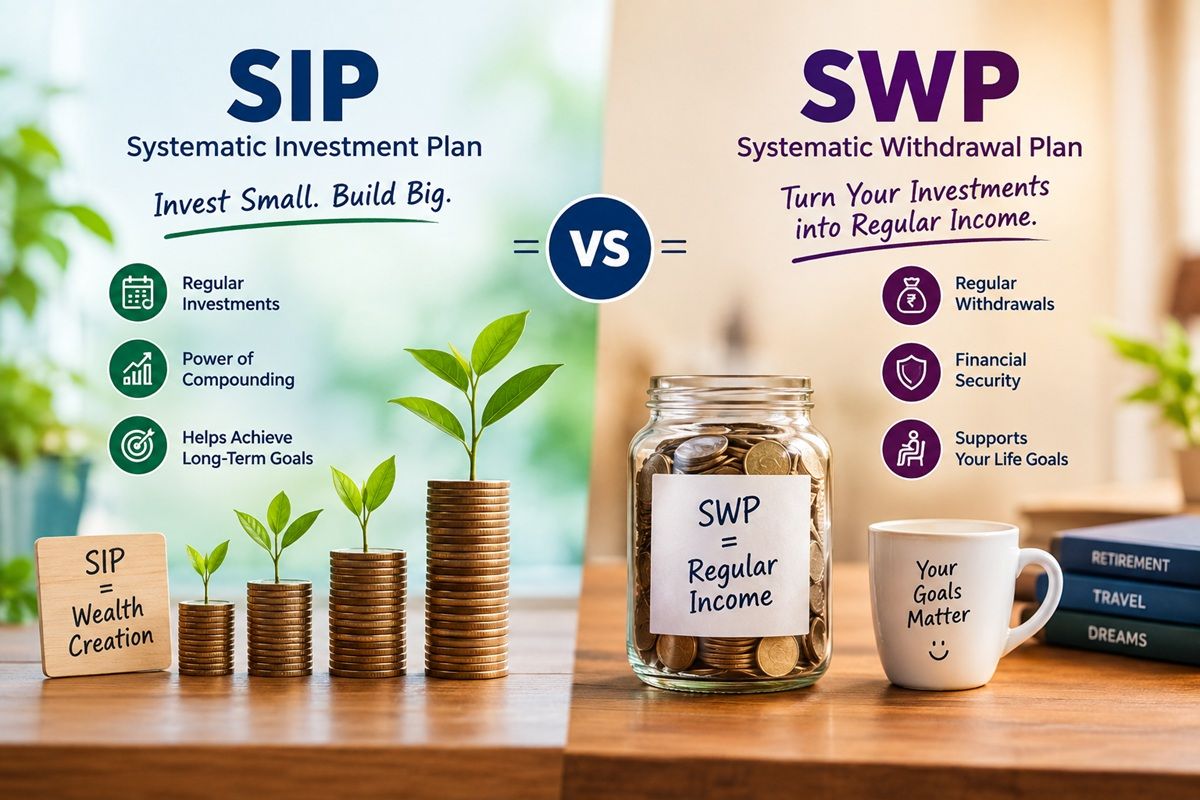
- What Is a SIP (Systematic Investment Plan)?
- How a SIP Actually Works, Step by Step
- Key Features of a SIP
- Benefits of Investing Through a SIP
- What Is an SWP (Systematic Withdrawal Plan)?
- How an SWP Actually Works, Step by Step
- Key Features of an SWP
- Benefits of Using an SWP
- SIP vs SWP: How They’re Genuinely Different
- Why These Two Are Often Used Together
- How to Start a SIP: A Simple Walkthrough
- How to Start an SWP: A Simple Walkthrough
- Tax Treatment: What You Actually Owe
- Taxation on SIP Investments
- Taxation on SWP Withdrawals
- Common Mistakes to Avoid
- Frequently Asked Questions
- Can I have both a SIP and an SWP running at the same time?
- What is the minimum amount required to start a SIP?
- Is SWP only for retirees?
- Does SWP guarantee my corpus will never run out?
- Can I change my SIP or SWP amount later?
- Which is better for retirement planning — SIP or SWP?
- Conclusion
Ask most Indian investors what SIP means, and they’ll answer without hesitation — it’s practically become a household term. Ask the same person what SWP means, and you’ll often get a blank stare, even though it’s really just the reverse side of the same coin. One helps you build wealth. The other helps you actually use it.
The numbers show just how mainstream SIPs have become. According to AMFI (Association of Mutual Funds in India), monthly SIP contributions hit a record ₹31,961 crore in July 2026, with SIP assets under management touching ₹18.20 lakh crore and equity mutual funds extending a 63-month streak of continuous net inflows. That’s not a niche investment habit anymore — it’s how a huge share of India actually invests.
SWP hasn’t caught on nearly as widely yet, mostly because fewer people have reached the stage where they need it. But if you’re planning for retirement, a career break, or simply want a predictable monthly cash flow from savings you’ve already built, understanding SWP is just as important as understanding SIP. This guide covers both in full — what they are, how they actually work, their real benefits, and exactly how to set each one up.
What Is a SIP (Systematic Investment Plan)?
A Systematic Investment Plan, or SIP, is a method of investing a fixed amount of money into a mutual fund scheme at regular intervals — typically monthly — instead of investing a large lump sum all at once. You decide the amount, the frequency, and the mutual fund scheme, and the money gets auto-debited from your bank account and invested on the same date every month.
Think of it as an automated savings habit that happens to be invested in the market, rather than sitting idle in a savings account. You set it up once, and it keeps working in the background without needing your active involvement every month.
How a SIP Actually Works, Step by Step
- You choose a mutual fund scheme based on your financial goal and risk appetite — equity, debt, or hybrid.
- You decide the SIP amount (as low as ₹100-500 per month for many schemes) and the date it should be debited.
- You set up an auto-debit mandate through your bank, usually via a National Automated Clearing House (NACH) authorization.
- On your chosen date each month, the fixed amount is debited and used to purchase units of the mutual fund at that day’s Net Asset Value (NAV).
- Over time, this builds up a growing number of fund units, and your investment compounds as the fund’s underlying value grows.
Key Features of a SIP
- Flexible amounts. Most fund houses now allow SIPs starting from as little as ₹100 to ₹500 a month, making it accessible regardless of income level.
- Choice of frequency. While monthly is most common, some funds also offer weekly, quarterly, or even daily SIP options.
- Rupee cost averaging. Because you invest the same amount regardless of whether markets are up or down, you automatically buy more units when prices are low and fewer when prices are high — smoothing out your average purchase cost over time.
- Power of compounding. Returns generated on your investment start earning their own returns, and this effect becomes considerably more powerful the longer you stay invested.
- Easy to pause or stop. Most SIPs can be paused, modified, or cancelled without penalty, giving you flexibility if your financial situation changes.
- Step-up option. Many platforms now offer a “Step-Up SIP” feature, letting you automatically increase your SIP amount by a fixed percentage each year, in line with rising income.
Benefits of Investing Through a SIP
- Removes the guesswork of timing the market. You don’t need to predict whether markets will rise or fall tomorrow — you simply keep investing on schedule.
- Builds financial discipline. Because the amount is auto-debited, it removes the temptation to skip investing in a given month.
- Works with any budget. You don’t need a large sum of money to start; you can begin small and increase your contribution as your income grows.
- Reduces the emotional impact of volatility. Since you’re investing small amounts regularly rather than one large sum, market dips feel less stressful — they simply mean you’re buying more units at a lower cost.
A practical example: Suppose you start a SIP of ₹5,000 a month in an equity mutual fund. Over 15 years, assuming the fund delivers a reasonably conservative average annual return of 12%, your total investment of ₹9 lakh (₹5,000 × 12 months × 15 years) could grow to approximately ₹25 lakh — nearly 2.8 times your invested amount, purely through the combined effect of compounding and consistent investing. Actual returns will vary depending on the specific fund and market conditions, but this illustrates why time in the market matters more than trying to time it.
What Is an SWP (Systematic Withdrawal Plan)?
A Systematic Withdrawal Plan, or SWP, works in the opposite direction of a SIP. Instead of investing money into a mutual fund at regular intervals, you withdraw a fixed amount from an existing mutual fund investment at regular intervals — typically monthly — while the remaining corpus stays invested and continues to grow (or at least has the chance to).
SWP is most commonly used by retirees or anyone who wants to convert a lump sum of accumulated savings into a steady, predictable monthly income stream, without withdrawing the entire investment at once.
How an SWP Actually Works, Step by Step
- You invest a lump sum (or transfer an existing investment) into a mutual fund scheme.
- You set up an SWP instruction specifying the withdrawal amount and frequency — usually monthly.
- On the specified date each period, the fund house automatically redeems mutual fund units equal to your chosen withdrawal amount, based on that day’s NAV.
- The redemption proceeds are credited directly to your registered bank account.
- The remaining units continue to stay invested, continuing to earn (or lose) returns based on market performance.
Key Features of an SWP
- Customizable withdrawal amount and frequency. You decide exactly how much you need and how often — monthly, quarterly, or even annually.
- The remaining corpus stays invested. Unlike withdrawing your entire investment at once, an SWP lets your remaining balance continue participating in market growth.
- Flexibility to modify or stop anytime. You can increase, decrease, pause, or completely stop your SWP whenever your income needs change.
- Works across fund types. SWPs can be set up on equity, debt, or hybrid mutual fund schemes, depending on your risk tolerance and how the money will be used.
Benefits of Using an SWP
- Creates a predictable income stream. This is genuinely useful for retirees who need a monthly “paycheck” replacement once regular employment income stops.
- More tax-efficient than it might first appear. Since each withdrawal is technically a partial redemption of units, you’re only taxed on the gain portion of each withdrawal, not the entire amount — a meaningfully different (and often more favorable) tax treatment compared to, say, interest income from a fixed deposit, which is fully taxable at your slab rate.
- Keeps the remaining money working for you. Rather than pulling out a lump sum and letting it sit in a low-interest savings account, an SWP allows the untouched portion of your corpus to continue potentially growing.
- Reduces the risk of overspending. Because you’re withdrawing a fixed, planned amount rather than dipping into savings whenever needed, an SWP encourages disciplined spending in retirement, similar to how a SIP encourages disciplined saving during your working years.
A practical example: Suppose you retire with a mutual fund corpus of ₹50 lakh and set up an SWP to withdraw ₹30,000 a month. That works out to ₹3.6 lakh a year, or roughly a 7.2% annual withdrawal rate. If the underlying fund continues generating average returns in the 9-10% range annually, your corpus could potentially sustain this withdrawal rate for a long period, possibly even continuing to grow in nominal terms, depending on market performance in any given year. If returns fall short of your withdrawal rate for an extended period, though, the corpus will gradually deplete faster — which is exactly why choosing a sustainable withdrawal rate matters enormously.
SIP vs SWP: How They’re Genuinely Different
| Aspect | SIP | SWP |
|---|---|---|
| Purpose | Building wealth over time | Generating regular income from existing wealth |
| Cash flow direction | Money flows out of your bank account into the fund | Money flows out of the fund into your bank account |
| Best suited for | Younger investors, long-term goals, career-stage earners | Retirees, those needing regular income, post-retirement planning |
| Effect on unit balance | Number of units held increases over time | Number of units held decreases over time |
| Ideal market condition to start | Any time — averaging works in both rising and falling markets | Best paired with funds that have some stability, since regular redemptions during a sharp downturn can accelerate corpus depletion |
Why These Two Are Often Used Together
Here’s a detail that doesn’t get talked about enough: SIP and SWP aren’t really competitors — they’re two phases of the same long-term financial journey. A genuinely well-planned approach often looks like this: use a SIP through your working years to build a substantial mutual fund corpus, and then, once you retire or need regular income, switch that same corpus (or transfer it to more stable, income-oriented funds) into an SWP.
This SIP-to-SWP transition is essentially how a self-directed retirement income plan works, without needing to rely purely on pensions, annuities, or fixed deposits.
How to Start a SIP: A Simple Walkthrough
- Complete your KYC (Know Your Customer) process if you haven’t already — this is mandatory for any mutual fund investment in India and can be done online through most fund houses or platforms.
- Choose a mutual fund scheme based on your goal, time horizon, and risk appetite — equity funds for long-term growth, debt funds for stability, hybrid funds for a mix of both.
- Decide your SIP amount and date — pick a date shortly after your salary or income typically arrives, so the auto-debit doesn’t strain your monthly cash flow.
- Set up the auto-debit mandate through your bank or the investment platform, authorizing recurring deductions.
- Monitor periodically, not obsessively — a quarterly or half-yearly review is usually enough; checking daily tends to trigger emotional decisions that work against the whole point of a SIP.
How to Start an SWP: A Simple Walkthrough
- Ensure you already have a mutual fund investment — either a lump sum you’ve invested specifically for this purpose, or an existing SIP corpus you’re ready to start drawing from.
- Decide your required monthly withdrawal amount based on your actual expenses, ideally keeping the withdrawal rate sustainable relative to your corpus size and expected fund returns.
- Choose the right fund type — many retirees shift a portion of their corpus into more stable, debt-oriented, or conservative hybrid funds before starting an SWP, to reduce the risk of large redemptions happening during a market downturn.
- Submit the SWP request through your fund house’s website, mobile app, or your financial advisor, specifying the withdrawal amount, frequency, and start date.
- Review annually — reassess your withdrawal rate periodically, especially if markets have performed particularly well or particularly poorly, to make sure your corpus stays on track to last as long as you need it to.
Tax Treatment: What You Actually Owe
Taxation on SIP Investments
SIP investments themselves aren’t taxed at the time of investing — tax only applies when you eventually redeem your units. For equity mutual funds, gains are classified as Short-Term Capital Gains (if held under 12 months) or Long-Term Capital Gains (if held over 12 months), each taxed differently. It’s worth noting that each individual SIP instalment is treated as a separate investment for tax purposes, meaning each month’s units have their own holding period starting from the date of that specific purchase.
Taxation on SWP Withdrawals
This is where SWP often works out more tax-efficiently than people expect. Each SWP withdrawal is treated as a partial redemption, and tax applies only to the gain portion of that redemption — not the entire withdrawal amount. Depending on how long those specific units have been held, the gain is taxed as either short-term or long-term capital gains, following the same equity or debt fund tax rules that apply to any other mutual fund redemption.
This is meaningfully different from something like fixed deposit interest, where the entire interest amount is added to your taxable income every year, regardless of how long you’ve held the deposit. With SWP, you’re only taxed on the profit embedded in each withdrawal, which can make it a genuinely more tax-efficient way to generate regular income, depending on your specific tax bracket and holding period.
Common Mistakes to Avoid
With SIP
- Stopping your SIP during a market downturn — this is precisely when rupee cost averaging works hardest in your favor.
- Choosing a fund based purely on recent short-term performance rather than consistency over multiple market cycles.
- Starting too small and never increasing the amount as income grows, which limits the long-term impact of compounding.
With SWP
- Setting a withdrawal rate that’s too aggressive relative to the fund’s realistic long-term returns, which can deplete the corpus faster than expected.
- Keeping the entire corpus in high-volatility equity funds when regular withdrawals are needed, rather than balancing with more stable options.
- Not reviewing the withdrawal amount periodically, especially after a period of poor fund performance.
Frequently Asked Questions
Can I have both a SIP and an SWP running at the same time?
Yes, though it’s more common to run them on different fund schemes for different goals — for instance, continuing a SIP toward a long-term goal while running an SWP from a separate, already-matured investment for current income needs.
What is the minimum amount required to start a SIP?
Many mutual fund schemes allow SIPs starting from as little as ₹100 to ₹500 per month, though this varies by fund house and scheme.
Is SWP only for retirees?
No, though retirees are the most common users. Anyone needing regular income from an existing investment — during a career break, for funding a child’s education in installments, or simply preferring a steady monthly cash flow — can use an SWP.
Does SWP guarantee my corpus will never run out?
No. Whether your corpus lasts depends on your withdrawal rate relative to the fund’s actual returns. Withdrawing more than the fund earns, especially during a market downturn, will gradually deplete the corpus over time.
Can I change my SIP or SWP amount later?
Yes. Both can typically be modified, paused, or stopped through your fund house’s platform or your financial advisor, usually without any penalty.
Which is better for retirement planning — SIP or SWP?
They’re not really competing options — they’re sequential. SIP is what you typically use during your working years to build the retirement corpus, and SWP is what you use afterward to draw a regular income from that same corpus.
Conclusion
SIP and SWP are really just two ends of the same investing journey — one focused on accumulation, the other on distribution. A SIP takes the guesswork and emotion out of building wealth by turning it into a disciplined, automatic habit. An SWP does something similarly valuable on the other end, turning a lump sum of accumulated savings into a steady, tax-efficient income stream instead of a pile of money you’re anxious about spending down.
With SIP contributions now crossing ₹31,000 crore a month across India and SIP assets standing at ₹18.20 lakh crore as of July 2026, it’s clear the accumulation half of this equation has genuinely gone mainstream. The withdrawal half deserves the same attention, especially as more Indians reach retirement with mutual fund savings rather than relying purely on pensions or fixed deposits. Understanding both — not just how they work individually, but how naturally they fit together across different life stages — puts you in a considerably stronger position to plan your entire financial journey, from your first working paycheck to your last day drawing income from your own investments.
Disclaimer: This article is for informational and educational purposes only and does not constitute investment advice. Mutual fund investments are subject to market risk. Please read all scheme-related documents carefully and consult a SEBI-registered financial advisor before making any investment decisions.